Vista - Stephanie Lake Company
Home | Blog | Vista and Two Blood
Vista and Two Blood
VISTA and TWO BLOOD
Yet again I have experienced back to back dance programs at Carriageworks on Wilson Street in Everleigh, situated conveniently just a hop, skip, duck, tuck, roll and break fall from my regular judo classes at the Sydney University Sports and Aquatic Centre. Before I unpack the two evenings events in review I have to say, that although the action in the foyer in the lead up to a show remains a tad lacklustre (however that totally could be down to my rushed entry via the dojo) the in-theatre experience never fails to satisfy. After the creatively flexible seating arrangements for the previous shows celebrating NAIDOC week, a more conventional audience placement resumed for the ensuing two productions of Stephanie Lake’s Vista and Australian Dance Theatre’s (ADT) Two Blood.
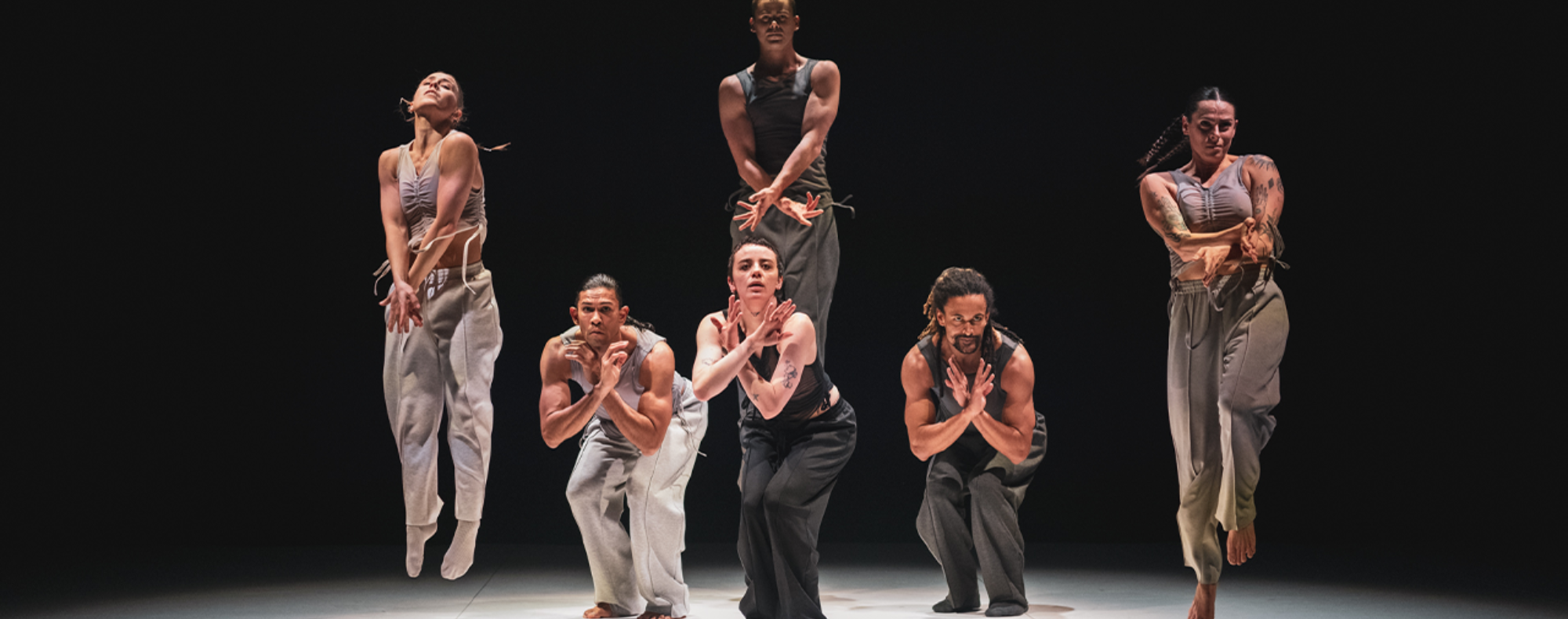
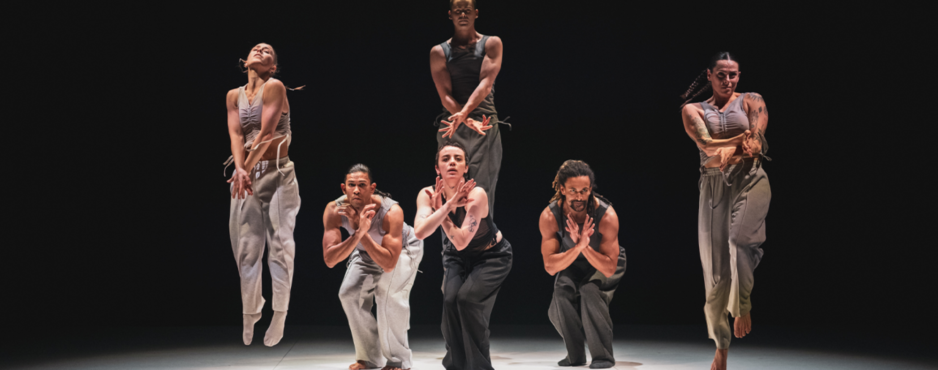
The first of the two works presented was choreographed by Stephanie Lake who brought her work Vista to us via their world premiere at the Rising Festival (formerly Melbourne Festival). Lake, who has become renowned for her deft hand as a choreographer of major spectacles, including her work Manifesto, which featured nine drummers complete with full drum kits sharing the stage with nine dancers and Colossus, whereby Lake demonstrated she was able to wield a cast of fifty with relative ease. Despite the downsizing of the number of bodies on stage in Vista, Lake managed to generate the same amount of energy from this cast of six in Rachel Coulson, Tyrel Dulvarie, Marni Green, Hugo Poulet, Robert Tinning and Georgia Van Gils. Put simply, the dynamics on stage were relentless in intensity and consistency. The precise attention to detail in the execution of large bold choreography and in the use of intricate gesture was, as expected, impressive.
As a choreographer myself I am always interested in the choice of a title and upon contemplation of Lake’s title I was initially perplexed. I had erroneously assumed the definition of vista was the description of a panoramic landscape, therefore as each successive sequence was initiated I attempted to apply this concept of topography. However, in this case my failure to read the program notes beforehand actually enhanced my experience as I interpreted the second act of the show to be a type of excavation of the territorial facets introduced in act one. As the bodies traversed the stage, instead of trying to allocate emotive meaning, as the program suggested, I felt I was being made privy to the secret knowledge embedded in an unspecified but definite urban geographical site.
It was interesting that I actually did fulfill Lake’s brief in that my Indigenous cultural loading did actually steer my interpretation of the work as Lake had intended.
In hindsight, this concept of vista as a physiological outlook or emotive terrain was realised through Lake’s choice of cast as each dancer exuded their own aura – Marnie Green exhibited a delicate vulnerability especially in her solo, featuring a series of small, almost imperceptible gestures onto which a succession of duets were hung, whereas Rachel Coulson possessed an air of stability, her physical proficiency grounding and solidifying the group dynamics, while Georgia Van Gils embodied the explosive power of a rocket. Robert Tinning’s presence served as an amplification to the action. In one scene with Hugo Poulet it was the slight magnification of the movement in Tinning’s hips which prompted me to think of the type of healthy competition that exists within some dance companies, which sets off a chain reaction of excellence. All the while Tyrel Dulvarie proved mysterious in contrast to the rest of the cast, moving with a tempered lyricism throughout both halves of the Vista program.
As the show progressed I recognised how rare it is to behold the company experience that enables each dancer to shine for their individual artistic contribution of late, of being able to cultivate a favourite dancer within a sea of virtuosic bodies. I remember being excited about going to Sydney Dance Company and waiting for Bradley Chatfield to make an entrance. I remember that feeling of subconsciously holding my breath every time I saw Janet Vernon dance, only to register that response of incredible awe when I subsequently exhaled.
So from one intense experience delivered by Lake in Vista, I move to the next, to Australian Dance Theatre’s presentation of Two Blood. The narrative was realised by a team of choreographic creatives in Daniel Riley, Jasmine Sheppard and Brianna Kell in collaboration with the performers. Writer S.Shakthidharan, renowned for his multi award winning epic play Counting and Cracking, supplied the text which shaped the structure of the work. Presented in the guise of a forbidden romance, Two Blood drew upon aspects of Jasmin Sheppard’s own personal family history. Two Blood was planted firmly in the indigenous canon of storytelling by utilising an interdisciplinary expressive format including film and interactive set design alongside the spoken text and dance.
Whereas Vista opened with a choreographic tightness that could almost be described as clinical compared to its second half, Two Blood revelled in its repeated expressions of violent chaos. The opening featured performer Karli Sheppard alternately whispering and growling, the embodiment of a firestarter, an agent of mayhem, as she moved within a circle of ash (?). This was followed by the entrance of the other performers who subsequently disrupted that circle causing its particles to scatter the stage like a constantly shifting constellation reflected upon the Earth’s surface.
Two Blood was replete with an abundance of (melo)drama including archetypes of ancestral guardians, and hero protagonists who overcome adversity to come together.
In Two Blood, we were treated to a clash of the disparate cultures involved – from the amorphous choreographic formations expressing connection to ‘country’ of the Indigenous ancestors, to the dances occurring between two LED screens depicting the geometric angularity representative of Asian architecture, thought and social structure.
While Vista, was delivered in an overwhelming, yet steady, wash of physical virtuosity whereby interpretation was derived through the dynamic treatment of embodied semiotics, in Two Blood the narrative arc was derived in distinct scenes of mimetic action. Outstanding moments within Two Blood included the female duet of Karli Sheppard and Zoe Wozniak as the depth of Wozniak’s physicality became the embodied manifestation of Sheppard’s power. Joshua Doctor, whose angelic voice as song man closed the first act with an understated strength, was no less potent for its comparative gentility establishing the world in which Two Blood was initially located. The use of spoken language in Zachary Lopez’s solo in which he played the Asian lover going against his cultural expectations was pleasurable to experience. Because it was unintelligible to me it served as a musical score, heightening the emotive intent behind the choreography, rather than overtly mirroring, or explaining the action.
The Carriageworks seasons of both Vista and Two Blood were but pitstops on a larger touring program and so if you get the chance to see either I recommend you grab a ticket. In the meantime watch this space for the next blog, coming sooner than you might think.