Current - Sydney Dance Company
Home | Blog | Sydney Dance Company Current Part 2
Sydney Dance Company Current Part 2
In this blog I don’t want to talk about yet another performance celebrating forty years on the wharf because if I just focus on the kinaesthetic machinations of Sydney Dance Company you will miss out – big time.
In this, the second installment I want to zero in on the comprehensive work of visual artist Kelvin Robertson and the visual arts contribution of dancer choreographer Paul Saliba.
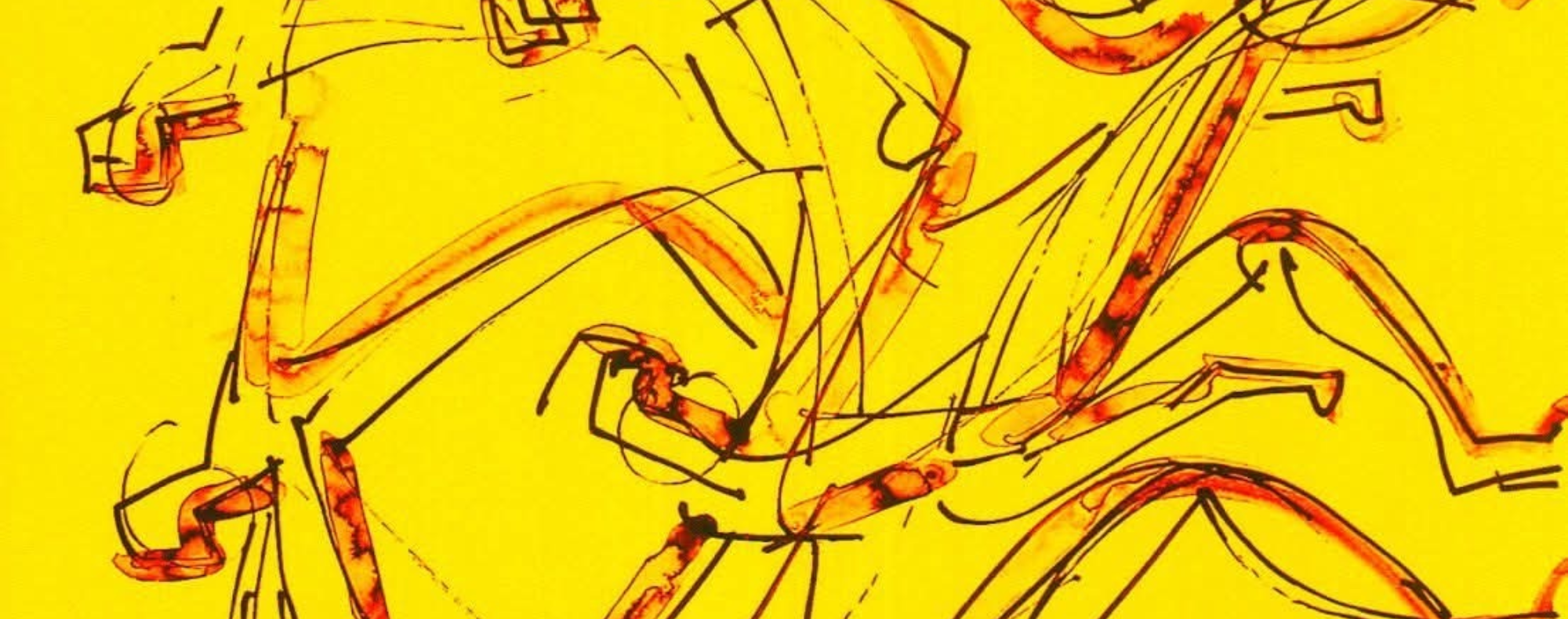
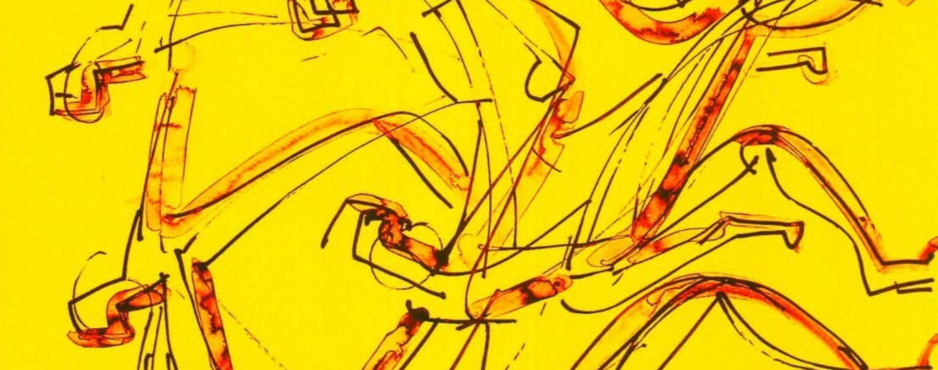
Long time mentor and dancer Karen Kerkhoven first introduced me to Robertson’s artwork when she spotted one of his paintings hanging in the foyer of Parramatta Riverside Theatres. If her eye hadn’t caught the image hanging in an unassuming spot on one of the pylons I surely would have missed it. Kerkhoven then proceeded to supply a detailed summary of Robertson’s longtime association with Sydney Dance Company, just as we were about to watch a show in the Lennox theatre, talking of how he would draw and paint them in the studio, in rehearsal. Looking at Kerkhoven’s work (one of which hangs in my kitchen just above the fridge) I can see Robertson’s influence on her art, and in turn both Kerkhoven and Robertson’s mutual interest in the work of Henri Matisse, more specifically his Blue Nudes series.
Before I steer you down the garden path and have you think that somehow Robertson’s, and by association Kerkhoven’s, visual outputs are derivative, I want to posit a theory for their preferred representations of the body. Let me begin by reminding you of the well worn argument of the ephemeral nature of dance. Thanks to AI I needn’t illegally trawl through a mass of academic tomes and papers I no longer have access to, having recently completed my studies, to forward this well documented opinion, first identified through my Google buddy as posited by ballet master Jean Georges Noverre in 1760 in his Letters on Dancing and Ballets and leading right up to one of my favourite dance theorists Andre Lepecki, who extrapolated on this assertion to include the logistical and economic ramifications of the art form. For Lepecki opines that, “we arrive, to an understanding of dance as elusive presence, dance as the fleeting trace of an always irretrievable, never translatable motion: neither into notation, nor into writing.” (Lepecki, 2004, p. 125)
Let me challenge Lepecki’s observation in relation to the work of Robertson. For I don’t interpret Robertson’s visual efforts as mere representations of the dance, but as expressions of dance in and of itself. By making his art in the room with the dancers Kelvin Robertson became a dancer himself in partnership, both spatially and kinaesthetically. Kelvin found and built upon a methodology, of physical techniques if you will, of creating images whereby he could participate in temporal tandem with them. His abstract acrylics, cut outs and ink on paper are not merely painstaking reflections, but deft energetic extensions, also affording us an inclusive experience, as our eyes in turn dance over and over his images. His images, as supple in line and movement as the bodies he himself trained, rehearsed and performed with.
Robertson embarked on his career as a movement artist upon his return from study in New York, at the invitation of theatre director and teacher Brian Syron to draw his actors in rehearsal.
Serendipitously two dancers in attendance at Syron’s City Acting Studio, Susan Barling and Nina Veretennikova prompted his request to former Sydney Dance Company artistic director Graeme Murphy to sketch his dancers in situ. Again, through a combination of networks forged while at SDC and inimitable zeal, Robertson consolidated his affiliation with New York and America through his entry into the studios of Miami City Ballet and Paul Taylor Dance Company.
From Kerkhoven I learned that Robertson has recently made a transition into the realm of music, which includes singing in his local Baptist choir in New York, where he has relocated and been living for more than a decade. Of course the church choirs in New York are legendary for their rousing energy and some for their sheer scale. From what I have spied through Robertson’s socials he has been hitting up some of the larger ecclesiastical stomping grounds. Also through Kerkhoven I was informed of an early attempt to get Roberson’s paintings on the sails of the Opera House. I think in this the 50th year of the flagship company’s presence, forty of which have been spent at the historic pier, it is time to reignite that petition and let the world see the vibrancy of the dance through his brush, scalpel and scissors – to bear witness to the endless spirals, clinches, contorted shapes and entertwinings, writ large on the same harbour that has ignited and housed so many of the company’s notable works.
From the prolific visual contribution of Robertson I want to also share with you the visual musing of Paul Saliba who, like Robertson, has hung in the hallowed hallways of Sydney Dance Company.
Unlike Robertson, who took up ballet very briefly at the age of ten, in a world where makeup and tights were at odds with the blokey image of the typical Aussie, Paul Saliba joined and thrived. Saliba would enjoy a full career as dancer/ choreographer with the Australian Ballet before moving to Sydney Dance Company and then transitioning to teach us Blakfellas in Glebe at NAISDA.
I remember showing Paul some of my drawings, as I was accepted into several tertiary visual arts institutions upon leaving high school, only to choose dance, the very thing my ungainly body seemed ill fitted for. I recall him remarking that if he possessed my skill he would quit dancing in a heartbeat. Little did I know then that he too was an artist in his own right.
Unlike Robertson, Saliba did not draw the dance in real time. The work I saw of Saliba’s were the subject of corroboree rituals. A true cross- cultural reckoning of his Maltese-Australian heritage meets classical dance training, meeting his everyday Aboriginal cultural immersion at NAISDA. Like Robertson, Saliba’s artwork was busy with movement. Unlike Robertson, whose bodies were comparatively few in number, sometimes I saw bodies like ants crawling en masse over Saliba’s canvases. Still dancing though.
I had to rummage through my house to find my one prized artwork of Saliba’s. A sarong three of us, Kuku Yalanji dancer Henrietta Baird, Yolngu dancer Rosealee Pearson (?) and I were gifted over two decades ago. The colours – bright yellow and green. The images – a kaleidoscope of dancing spirits, small dancing bodies – and fish.
I will take a picture of my Saliba sarong. The fabric is crumpled, however I think it adds to the image, making it appear like paperbark. Saliba’s work is important because it speaks to the future of Indigenous Art, to its possible accessibility by all without the burden of, or being shackled by, the fear of appropriation. Saliba’s visuals speak of his close relationship to the communities he came in touch with through a meaningful, mutual and reciprocal respect and acknowledgement of, and sharing.
If not on the lofty sails. I think it is time these two truly inspiring interdisciplinary artists works made a reappearance for the public around the busy thoroughfare of the SDC entrance.
Lepecki, A. (2004). Inscribing dance. In A. Lepecki (Ed.), Of the presence of the body: Essays on dance and performance theory (pp. 124–139). Wesleyan University Press.