Home | Blog | Flora, DUELS and That’s Two, Thank You
Flora, DUELS and That’s Two, Thank You
In the space of a week I witnessed three dance performances beginning with the mammoth production that was the collaboration between the Australian Ballet and Bangarra Dance Theatre to present Frances Rings’ Flora followed by two performances programs in That’s Two, Thank You and Duels, both produced and presented by FORM Dance Projects, which packed an equally big punch. What can I say, except that there was certainly something for everyone this past month.
Turns out, more than I could poke a stick at, as I missed what I heard was a promising outcome from this year’s Dirtyfeet Choreographic Lab held at Critical Path, which saw newly appointed mover and shaker of Force Majeure Nick Power (huge congratulations btw) mentor a stunning group of hip hop/ contemporary crossover artists.
As I reread this blog for the edits I will inevitably miss due to my propensity to automatically autocorrect myself without actually making any amendments I realise that this entry should really be served in two instalments so I will prompt you when to take a well earned break.
Here goes…
Frances Rings’ Flora could not be described as anything other than epic. This work was so grand that it rendered the Dame Joan Sutherland theatre diminutive at times, with the combined casts of Bangarra and the Aussie Ballet each vying for their own piece of prized real estate in which to embody the native vegetation of this continent. However, as usual the opening scene made such a big optical impact that the oft times overcrowding was not immediately made apparent. From the outset, my eye was caught by the striking torso articulation of dancer Chantelle Lee Lockhart even before she began her solo. This is a pesky habit of mine and many other regular attendees of dance whereby, amongst a sea of very competent performers, there is a singular artist who brings to the stage an undeniable charisma, demanding our attention. What a way to make a splash Chantelle!
However, the image I will walk away with in this opening gambit is the moment where the women come together in a tight formation, dead centre of the stage and one woman holds her digging stick aloft, breaking through to another realm to connect with an amorphous entity suspended above. Consisting of multiple harnessed bodies writhing from the ceiling this meeting of earthly and otherworldly quiddities set an impeccable standard and equally almost impossibly high expectations.
As usual I did not read the two page synopsis (nor did I purchase a programme) until well after seeing the work and because the information embedded in the content of the work was at times very detailed, I wondered if there is a more expedient way of disseminating some of the information in preparation to, or while witnessing what is transpiring. Or alternatively, as philosopher Roland Barthes argued in his seminal 1967 essay titled, The Death of the Author does, or should, the choreographic intent matter as the audience is able to make their own meaning from the action transpiring on stage. With this in mind, as usual I simply let the dancers take me on an abstract journey whereby I intuited each costume change heralded the commencement of a different vignette, aimed at eliciting a shift as another embedded fact, or truth of which I was not always in command of. And this was ok.
Despite the resulting busyness in dynamic I can appreciate the inclusion of so much unison group work in Flora, as this is an overt Australian Indigenous ontological representation of interrelatedness, an expression of an overarching cultural belief that all things are connected. Not to be confused with categorisation, which is a European philosophical construct realised to place man at the apex of all existence. With the ‘traditional’ dances, anybody who can dance is expected to participate as the group dynamics generates the right ambience, the perfect time, for summoning ancestors to perpetuate, to actualise and animate ‘The Dreaming’ – the spirit of the land.
The dance language employed in Flora was decidedly more balletic, obviously catering to the Australian Ballet dancers’ strengths with many a grande ronde de jambs abounding, albeit mostly performed in a grounded or fondued position of the supporting leg. Interestingly, there was a section whereby the dancers entered in black costumes adorned with bold gold coiled embroidered embellishments which instantly reminded me of the bronze wire spider dress, designed by sculptor Isamu Noguchi and worn by Yuriko, as Medea, in Martha Graham’s Cave of the Heart circa 1946/7. Much of the corresponding knee work featured in this section (I am sorry I am unable to locate the correlating title of this vignette) also transported me back to my formative training in the Graham technique both at NAISDA and at the Graham school in New York. Overall it was interesting to note that the language Rings employed was a great equalizer in that at times it was difficult to distinguish one company member from the other.
The closing image was also compelling as the ensemble of women were adorned in costumes, designed by Grace Lillian Lee, that rendered them living sculptures. The opening solo of this section, performed by Courtney Radford was both delicate and ethereal in presentation, truly prompting me to meditate on the diversity and beauty of our varied topographies and the floral entities which adorn them.
In hindsight I couldn’t help but wonder how the work would look if the very first and last images were swapped, as such a grand first impression left little wiggle room for the opportunity to build and shift dramaturgical tension. However, I absolutely love that the human element played second fiddle to the plant (for want of a better word) kingdom. This is also a nod to the Australian Indigenous way of being, doing and knowing whereby the plants are imbued with a voice, through the embodiment of the dancers, to speak their truth.
I think this is where we should take a break before attacking what turned out to be a mammoth undertaking as we shift venues from the Sydney Opera House to the Eternity Playhouse in Darlinghurst for the latest instalment of That’s Two, Thank You.
………………
All right– welcome back for part two of the month that was April.
I was somewhat heartened that Riverside Theatres, the usual venue for presenting FORM productions is in the middle of, or on the verge of, a makeover as this afforded me the opportunity to experience the nostalgic grandeur of the Eternity. This is truly an under utilised space and perfect for presenting intimate contemporary dance offerings. The theatre is smaller, but not diminutive by any means and I applaud FORM Director Paul Selwyn Norton for championing this space as a hub for contemporary dance into the future.
Unlike Flora, with its grand opulence witnessed from a notable distance, the first evening’s offering at the Eternity felt like a close secret shared with a selected gathering of avid fans who cross the theatrical threshold in the anticipation of the unexpected, which both That’s Two Thank You and Duels promised.
In a very unassuming manner b-boy Naethiel ‘Tango’ Lumbera entered the foyer with a boom box, and sat on it (or was it by it?) to simply make his presence known and we assembled accordingly, in the round, creating a singular cypher for him before he turned on the beats.
Instead of going out hard, like I have witnessed and seen on many of the online hip hop platforms, Tango began almost tentatively exploring the potential relationship between the sound and the body, more akin to a contemporary dance format, teasing us by picking up a short musical riff here and there before reassuring his pedestrian repose. These dance activations grew in duration and dynamics until he had exhausted the confines of the lower reception area to then simply pick up his box and resume on the mezzanine and before we knew it we were being led towards, and into, the theatre by his embodied call, like the pied piper summoning his erstwhile children.
After a brief period allowing us to settle into our seats the show proper began with another hip hop opening as Akuma Diva began an unabashed dalliance with the audience, using the street style of whacking as his language of enticement. Turns out director Anastasious Repousi had staged a conventional b-boy battle after all as Tango re-emerged from the audience and the two performers pitted their chosen styles against each other, the combative athleticsm of the crazy legs and street swagger versus the rapid circularity of the isolated appendages combined with the daring coquetry of the Ballroom, only to Merge as a fitting cohort and an equally apt title.
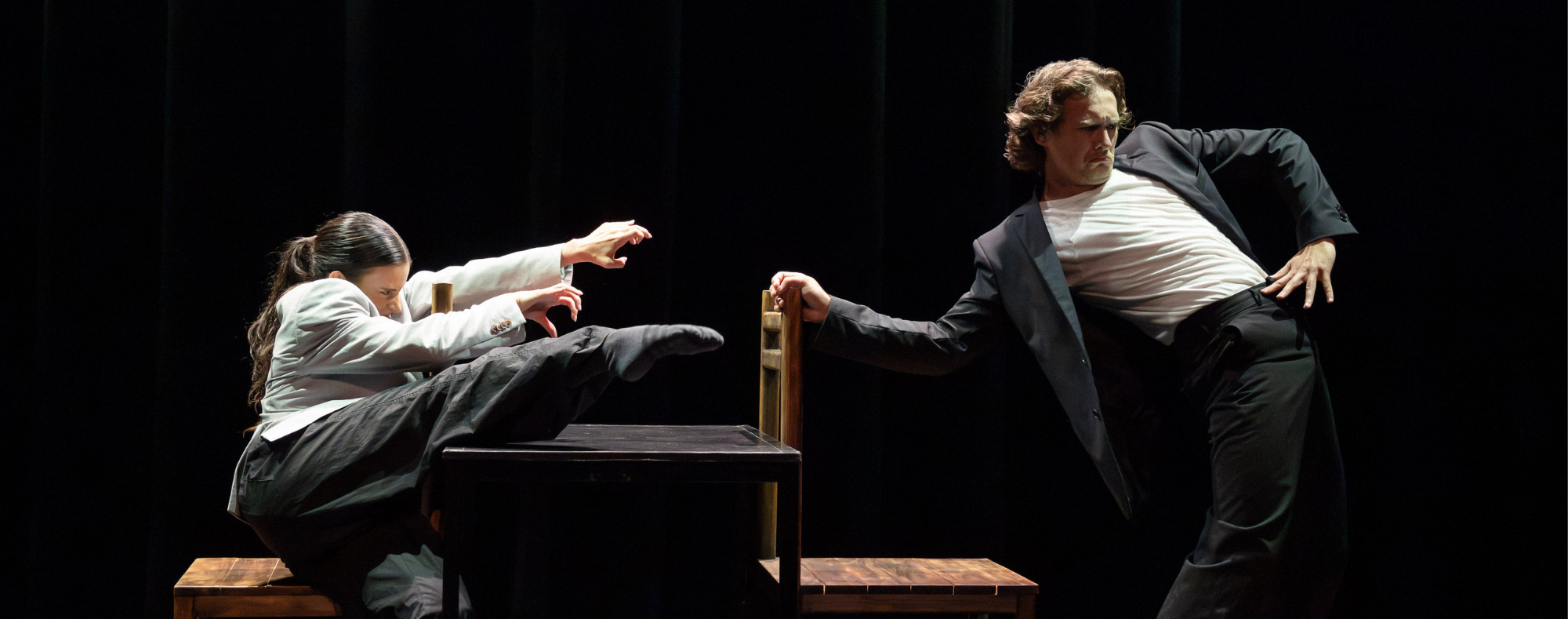
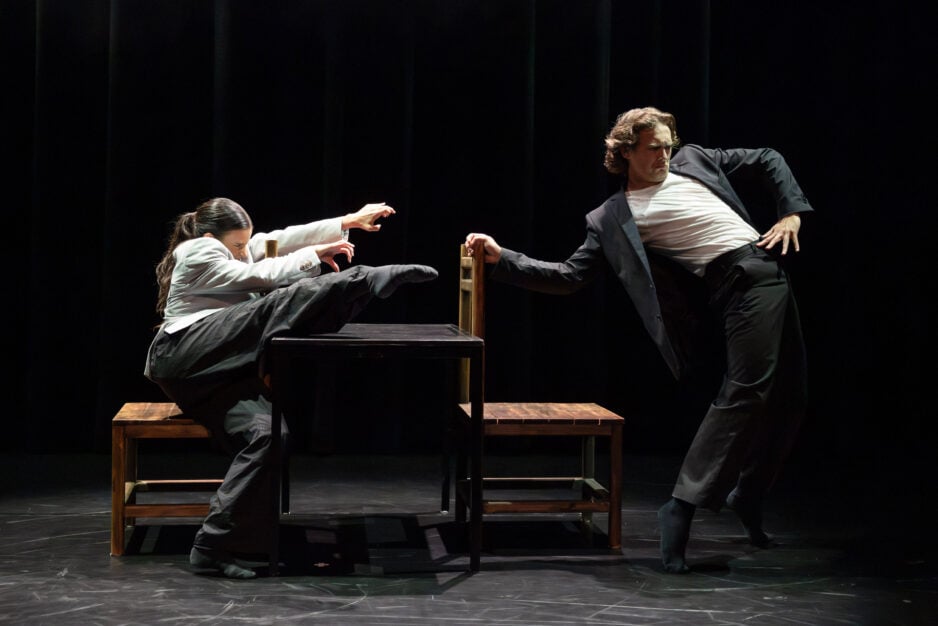
From Merge to Please Continue. I have seen this duet in many of its successive and successful guises for which you can refer to in the previous blog titled Hot Dances From the West. Each incarnation has been a joy to watch. Armed with two suit jackets, a swinging lampshade, a dining table and two chairs, Remy Rochester and partner Angus Onley perform, in around twenty minutes, the evolution of a romantic relationship that could well span a lifetime. Emotional milestones are punctuated by humour expressed through deft physical entanglements.
In the opening gambit of Please Continue the stage became a metaphor for tentative beginnings, as a short series of entries and exits became an apt analogy for the process of preparing, to make that positive first impression. A simple lighting device consisting of repeatedly sending the stage into blackness to reset in the act of a well trodden romantic trope, from a first kiss, to a first fight, to the first break up and subsequent make up. However, after exhausting what could have otherwise been rendered a cheap trick the work evolved through the culmination of an extended partnering sequence. Comprised of a large amount of low level floor work performed in unison, including shoulder balances involving extreme back arches interspersed with complex intertwined physical connections, the piece was imbued with an added sense of gravitas.
The last piece on the That’s Two program was an export from Taiwan. Part of Taipei based company Hung Dance, the third part of this triple bill was titled Push and Pull choreographed by LAI Hung-chung and performed by WU Shin-jie and LEE Kuan-ling. It too presented a relationship based on male, female coupling except in this rendering the power dynamics, which were playfully combative from both participants in the previous piece, were very much in favour of the male who appeared to dominate his partner. Right from the beginning LEE Kuan-ling appears to will WU Shin-jie into animated existence as he repeatedly activates her extremities until WU becomes a fully fledged being. Without the promotion of the program I could easily have interpreted this relationship as belonging to the canon of Pinocchio, or Frankenstein, whereby a lonely man creates a plaything of his very own. In this, the twenty-first century, it seems that this dream of creating a mechanical creature in our own human likeness remains a persistent preoccupation with all things AI at the forefront of this seemingly interminable ambition.
However despite the subtext, which I would never in a million years have guessed was inspired by the memories of LAI Hung-chung’s mother, the quiet resilience that occurs through yielding became apparent as the dance unfolded. The fact that WU could remain intact after so many manipulations and in so increasingly drastic a fashion was certainly mind boggling. The dance was just superb regardless of the intent. Flawless in its execution. As the piece progressed from predominantly gestural vocabulary towards larger abstract constructions I could feel the audience hold its breath, for until I had witnessed some of the movements unfold I was sure they could not have been executed without the aid of ice skates or some other hidden device. Take the repeated death spirals, which regularly features in pairs ice skating, whereby LEE spun while holding WU by one appendage and while WU was skating at impossible angles on one sock. Or the impeccable timing and flexibility involved by WU to create the appearance of an extremely submissive, or lifeless form, combined with the strength required by LEE to be able to perpetuate the appearance of malleability in those impossibly amorphous shaped transitions.
All I can say in closing to Push and Pull is – weren’t we lucky to be treated to this unexpected delight. From what I can gather after a brief Google stalk, this may have been but an excerpt of a larger work. I would very much enjoy seeing the work in its entirety and look forward to the future output from Hung Dance Company when it tours again of which I am in little doubt of this inevitability.
The last of the FORM Dance Projects That’s Two, Thank You programming was framed in the guise of a competition titled Duels, also presented in the Eternity Playhouse theatre. This year there were seven offerings from a range of experiences and styles. What I appreciate about the competition and the triple bill is the challenge to capture and express a concept, to express at least one clear objective with clarity, within such a truncated duration.
It’s always daunting to go first in these competitive situations, with so many pieces to come. The first piece sets the tone for the whole evening. From GUST-AGE choreographed by Georgette Sofatzis-Xuereb I witnessed two young dancers perform with fearless commitment. This was an appropriate entree into the evening as their performance heralded potential in enchantments consisting of bold declarative lines, creating a sculptural effect. The simple costuming with the male dressed only in dark long pants and the female, a singlet top and cotton underwear, reinforced a perception of innocence, of an open earnestness, the kind of which I could only express in my twenties when my courage was not tempered with the fear of being accepted, or appearing to do the right thing. Congratulations to Georgette for winning the audience choice award of the evening.
I am pretty sure the second act on the bill was titled the object, performed and choreographed by Hugo Poulet & Taiga Kita-Leong. It seems like I have witnessed these two performers grow up before my eyes through their combined participation in previous FORM Dance Projects events including Sharp Short Dance. I have certainly witnessed a growing artistic maturity in their stagecraft. I always look forward to seeing their playful interactions, a camaraderie expressed through sharp street like vocabulary interspersed with equally deft language from the contemporary movement lexicon. A highlight in this duet occurred in repetitive lateral progressions across the stage realised through a series of exits and entrances. This simple device built an atmosphere of curiosity and anticipation which had me wondering, ‘What will happen next?’
After a strong opening there is always a point where the need to mix things up occurs. This was certainly the case with PLATINUM, conceived and performed by Avalon Ormiston & Molly Haringsma. Their entrance, under what looked like a huge white doily which had grown blonde hair follicles, from which they emerged to reveal that they were doppelgangers also sporting long blonde locks, was nothing short of other worldly – the other worldly belonging to film director Tim Burton circa somewhere between Beetlejuice and The Corpse Bride, or director George Miller’s comedy horror The witches of Eastwick. Or even Shakespeare’s Macbeth at a pinch, through the introduction of a mirror as a property, as an Oracle where we could see elements of them in reflection, as if in possession of the ability to infiltrate another dimension. Curiously the use of the mirror briefly reminded me of Melanie Lane’s use of a mirror in her be winning kier choreographic entry, Personal Effigies (2018) to optically heighten her geometrical compositional aesthetic.
I will now depart from the running order of the proceedings to make a comparative note, for despite the difference in overall tone and aesthetics I found the work Backshore choreographed by Daniel Navarro Lorenzo in collaboration with AUSTI Dance and Physical Theatre also hearkened to another era. In this instance the costuming, despite the contemporary cut and drape of the floral patterned dresses, working in conjunction with the added whimsy of a featured reflective surface in a pool of water within a small silver shallow platter, was reminiscent of the Rococo Revival aesthetic. However in contrast to PLATINUM the symbolism in Navarro Lorenzo’s Backshore felt more open ended which led me to ponder, ‘Was the inclusion of the property an indictment on the place of leisure conducted in the environment? Or a reference to Narcissus who found more than solace in his own reflection? Or an allusion to the cleansing attributes of the liquid held within the metallic serving vessel?’
The inclusion of Nancy Duet by renowned choreographer Phillip Adams, who performed with Geoffrey Watson was an unexpected boon to the overall programming.
In this era of fast and easily accessible information we operate much faster. It’s as if our everyday embodiments are acting as weather veins, subsequently spinning erratically on their individual axes in empathy. The frenetic predilection toward busy vocabularic sequencing, consisting of many multiple movements per second, was offset by Nancy Duet which unfolded at a contrastingly considered pace. This temporal disruption was expressed through a series of formal poses which punctuated the dancers’ perambulation about the stage, including bent arabesques amongst an array of standing postures shifting into and out of the floor in the recumbent repose akin to marble sculptures. Yet again an allusion to another era was prompted in the form of head-kercheifs which were tied around the phalluses of their otherwise naked anatomy. This minimal costuming choice was reminiscent of the fig leaves ordinarily used to cover sex appendages of Renaissance artworks in an attempt to appear chastened, however in Adams’ work the opposite is both intended and achieved. In Nancy Boy this device is used to normalise and celebrate rather than morally admonish.
Eliza Cooper’s Entertain Me appeared somewhere near the second half of the second half of the bill. By this time I was surprised yet again by the diversity in the presentations. Through an extended sequence in unison Entertain Me transported us to an illusory nostalgic period for many who just missed the trends that included the parachute bloom of MC Hammer pants, the audible swish of nylon iridescent pastel tracksuits, the adolescent idolatry of Brittney Spears and Justin Timberlake and most importantly a time where the dance moves of Vanilla Ice and his crew could be emulated without a cringe factor. This was technically the period of my youth, alas I was hanging off the coattails of the Punk movement. Nevertheless, if anybody was going to be able to reimagine and repackage the relatively recent past, so much so that after a while I found myself wanting to eschew a logo for a smart two step with an erstwhile peppy concomitant, then Eliza Cooper would be just the gal to do it.
Entertain Me just crept up on us as the side by side two- step vibe morphed into something else completely. The joy the duo exuded became increasingly infectious as the sequence gained complexity. This can’t be denied nor swept under the carpet. Nor could we deny the skill in the execution from the duo performing those commercially recognised dance moves with equal amounts of technical prowess and absolute commitment, for it is the manner in which something is performed that transforms a piece of frivolity into a contemporary danced discourse on social behaviour.
While The Scale by Suan Kim with Sojung Bae was not last I left it to last because, drum roll………………… they were the winners of the Duels critics choice award affording them $3,500 to expand upon their current work! And rightly so. From the outset The Scale set itself apart from the other works as a piece which could easily sit in a darkened nook of a museum. Integrating tricky hand held lighting technology, the dancers illuminated themselves as outlines in the space, before we saw them interact in human form. The highlight of this piece occurred as one dancer mounted a plinth to balance and hover before looming larger than life with an apparatus which extended her arms to over twice their human breadth literally amassing disproportionate scale to the dancer who remained on the floor below. This work had an eerie quality that is difficult to achieve and maintain in a short format. If I were to make a comparison I would look to the visual artist Giorgie de Chirico who is renowned for his use of long shadow work, or chiaroscuro, and whose metaphysical surrealist paintings often featured a plinth while also flirting with the juxtaposition of amalgamated objects of distorted size and scale. In Suan Kim’s Scale the dance, while compelling, facilitated the articulation of her happening rather than operating as the overarching medium of expression.
Well folks, you made it to the end of another huge reflection. There was much to digest. Until next month.
Hot Dances from the West (Sydney) Pt. 2 – FORM Dance Projects https://share.google/Fjs97UiEWRUrpv60e