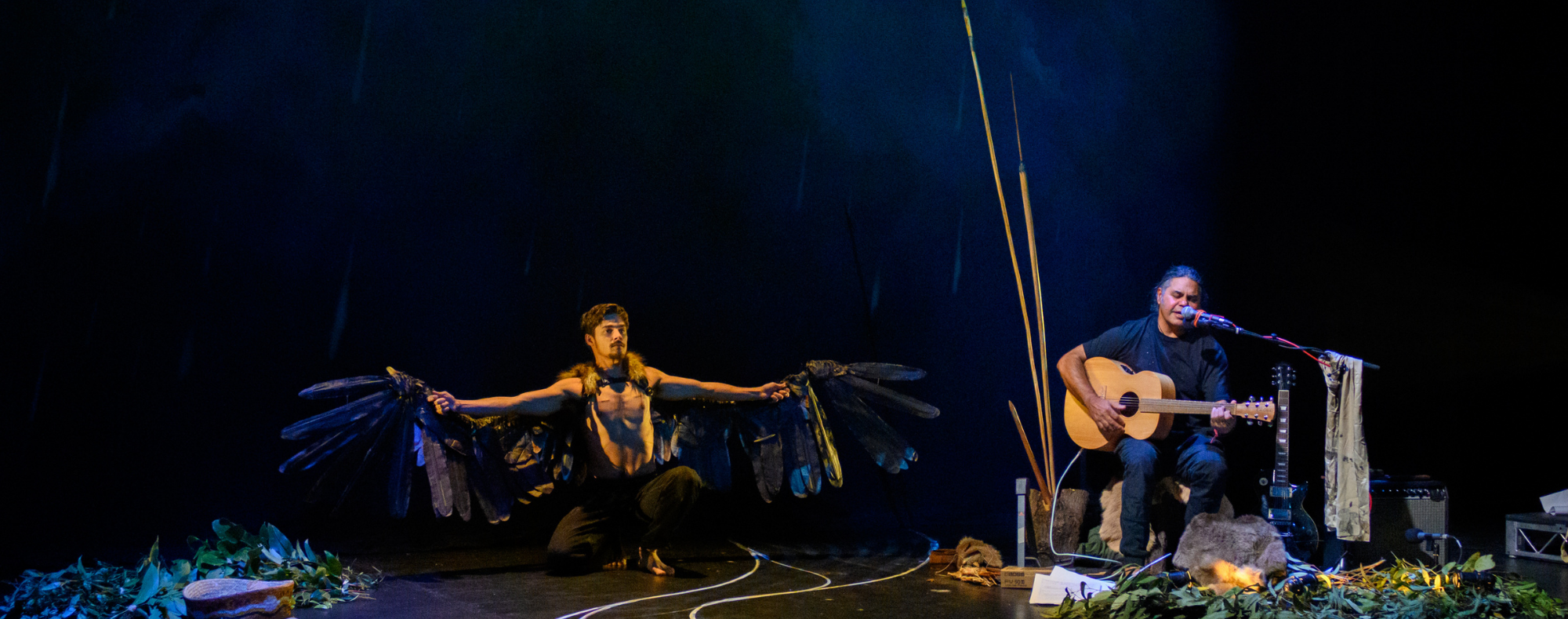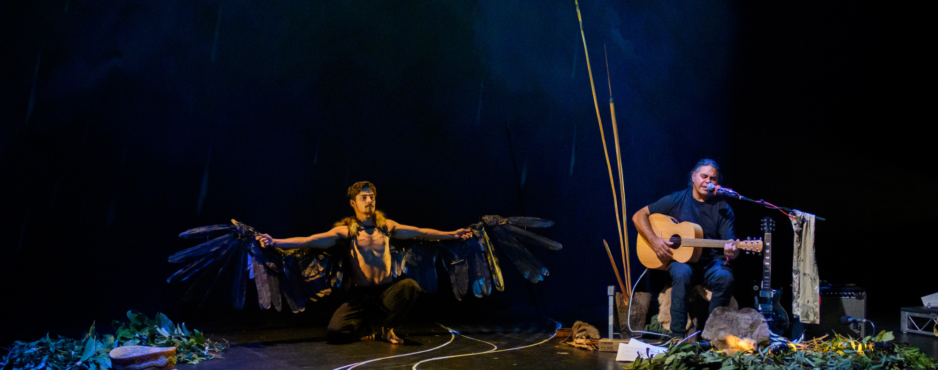
Healing Scars - Image: Jamie James
Home | Blog | NAIDOC PART 2
NAIDOC PART 2
NAIDOC Pt 2
From last week’s NAIDOC performances featuring contemporary biographical themes, this week I review works that illustrate how Aboriginal culture operates. The format – four performative offerings presented within two programs.
For this second blog, I found myself walking down the familiar left hand side of the seating bank of Bay 20 at Carriageworks as I had the week before. This time I processed down the darkened makeshift corridor to settle myself in for Yuwalaaraay musician and composer Warren Mason’s NAIDOC offering Healing Scars. Healing Scars was developed and presented through the Mooghalin Performing Arts initiative, the Yellamundie Festival, the biennial event which facilitated Warren Mason’s vision of creating performances honouring ancient cultural practices and narratives.
Upon entering the theatre, I discovered that the space had been configured in the round, well three sided, much like a corroboree gathering. When the show proper began, the lights zeroed in on Warren who animated the theatre with song and sound, from his seated position in the top right corner of the snugly enclosed stage space. Then, with a receptacle filled with white ochre and a long handled paint brush, Mason began to create a river, applying the ochre with deft swirling flourishes to indicate the circuitous direction of flow, complete with places to cross and stations to set down and make camp.
Through song, Mason introduced a majestic bird as the first entity to inhabit his country. The choreography of the bird attributed to both Jasmine Goulash (Gubbi Gubbi) and Jo Clancy (Wiradjuri), obviously created in conjunction with performer Kiarn Doyle (Dunghutti), and greatly enhanced by the uncredited costume designer, was stunning. When a dancer’s ego is sublimated and they become the thing they represent, it is a wondrous thing to behold. Every shimmy of Doyle’s body became a flutter, every hop and skitter, the act of claw like talons skimming the water for prey, outstretched arms were consummately transformed into wingspan for gliding and warming by the rays of the par can (Parabolic Aluminised Reflector lights) manufactured sunlight, before crouching into a protective perch to roost. Doyle’s contribution was a definite highlight.
After an interaction by the bird with Mason, who was orchestrator of the action in this Dreaming-scape, performers Jo Clancy and Lily Shearer entered consolidating the temporal setting by enacting gendered tasks resembling ‘women’s business’, of gathering and crafting and telling stories through the haptic practice of dirt drawing. Also known as sand mandalas, the knuckles, palms and fingers are used to communicate the history of a place and summon those first ancestor beings, in this case it was the bird who would show where to find fish and where to camp. In this instance it was Shearer who transported us to the Dreaming epoch through her portrayal of action while Clancy, as the conduit between us and the action on stage, created a contemporary stylised version of Shearers acts, sometimes without properties including coolamun (water carrier) and spear.
Another highlight of the show was the video projection element also incorporated with deceptive ease. The river ebbed and flowed through the precise confines of Mason’s initiating pictorial act while the action on stage was iterated in tandem on a cyclorama behind. Sometimes I felt the projections on the cyc could have been cut, and instead of an overall wash making the whole stage present, parts of the stage could’ve lain dormant, in darkness, so that we as audience members could zoom into those small pockets, creating a greater sense of intimacy and immediacy. However, having said that, the work did not feel overly busy either, more like a meditation giving us the option to switch back and forth through all of the disciplines on offer, akin to the appraisal of artifacts.
As with part one of my NAIDOC review I am playing catch up by unpacking Bangarra Dance Theatre’s program Sheltering, which was showing in the Dame Joan Sutherland theatre at the Opera House in the lead up to NAIDOC Week. The Sheltering program consisted of a triple bill of older works by Glory Tuoy Daniell, Daniel Mateo and Frances Rings.
I have seen three different versions of Glory Tuoy Daniell’s Keeping Grounded, the first as a part of Dance Clan, Bangarra Dance Theatre’s emerging choreographers initiative in 2023. Right away it was clear that the work was conceived with dramaturgical clarity, in the sense that the dynamic arc was satisfying to experience. What made the work more satisfying was in the recognition that it also had the potential to be further developed. Put simply, Keeping Grounded had legs, and good bones.
The action in Keeping Grounded was centred around a net, designed and built by Shana O’Brien, suspended from the ceiling and cleverly manipulated to carry dancers inside of it from above and to be consumed and covered by it from below. Consequently, not having read the program notes I, like many others, kept manufacturing a fishing narrative at first. Upon hearing it was actually based around the concept of what the ‘new age’ set also refers to as grounding, or earthing, or silent walking, in response to the evolution of footwear made with increasingly synthetic soles, I found myself becoming a harsher critic of the work.
However, by the second iteration, whereby Keeping Grounded was presented within NAISDA’s annual end of year show, titled the trees have voices, the feet have ears for which I was mentor and director, I had recognised that the literal lens with which I was wedded, was actually much more conceptually expansive. I found myself making a connection to the idea that being barefoot could also be a euphemism for being observant, for employing the cultural concept known as deep listening in relation to country, in order to be open to facets of the Dreaming canon. As opposed to our current predicament, to being distracted by technological assisted white noise.
It was then that I saw how Tuohy-Daniell’s Keeping Grounded acted as a primer illustrating the enabling of ancestral communication, and inversely as a portent of death when denied. One of the most powerful images involved three men engaging with the net as if battling their own individual demons. This vignette involved an act of perpetual spinning upside down while suspended, with another covering themselves in a shirt as if donning the headdress of the hangman which then evoked the harrowing image and still prevalent condition, of black deaths in custody.
In yet another vignette included in the second development, a duet was enacted from either side of the net, which I then interpreted in this context as a possible inability to return to the Dreaming, or for the possibility of the Dreaming to be beset by demise if radical change in relation to the environment is not employed. Again, I thought that this second iteration had room for a much bigger, more inclusive conceptual choreographic exploration that the non indigenous audiences could also easily identify and meditate upon.
By the time I had witnessed this work in the Dame Joan Sutherland theatre the cast and the net had doubled in size. I was in awe of the beautiful shapes and sequences Tuohy-Daniell was able to create, masterfully harnessing the physical virtuosity of the large cast, with many standout performances including a solo by Kassidy Waters and nearly every sequence containing Tammy Bouman who managed to repeatedly draw attention with her exquisite dynamics. However, despite the many powerful moments I was distracted by the overall busy-ness of action on this stage. Somehow the poignancy summoned in the previous iterations had been compromised, dissipated by this company rendition. Although I also have no doubt that this work will enjoy more seasons reclaiming and building upon its original message, as it sits well within the Bangarra repertoire as a powerful testament to, and in, the indigenous cultural continuum.
Just before my index finger clumsily started typing a description of Daniel Mateo’s Brown Boys, I realised that this work had much in common with the two works showcased in the first NAIDOC blog. Like Gary Lang’s The Other Side of Me and Michael Leslie’s Beyond the Tracks. Mateo‘s dance-poem-film is also biographical, incorporating a set and costuming that feels like a decidedly more ‘traditional’ representation of Mateo’s Tongan and Gomeroi heritage, operating in clever juxtaposition with text describing the coming of age hardships, of subtle acts of racism perpetrated against him, evoking the same kind of feel good nostalgia as Leslie’s Beyond the Tracks.
The dance in Mateo’s film, made in collaboration with choreographer and digital media artist Cass Mortimer Eipper did not stand out as the underpinning element in Brown Boys; instead choreographic craft could be located in the treatment of the images. From the way the eye travelled around the woven set and in the enhancement of its deconstruction, to reveal Mateo as the man that had emerged from his past, not discarding it but sitting with it – within it. The marriage of all of the disciplines was consummate in execution, including the pace of Mateo’s text which spoken in a deliberate slow drawl gave the viewer space to digest each new piece of information.
The 2026 Sheltering program was rounded out by Frances Ring’s Sheoak which enjoyed its debut in 2015. I was eagerly anticipating watching this work as I had missed the original season. Or so I thought. In fact I had seen it with my mother as part of the season titled Lore as part of a double bill, with I.B.I.S. choreographed by Waanenga Blanco and Deborah Brown, in the Merrigong theatre in Wollongong. Offset by the collaborative efforts of Blanco and Brown preceding it which were delightfully humorous and surreal, including a scene featuring women lined up by the freezer section, in a sultry reprieve from the heat, in the One-stop grocery store or the mass of bodies each representing the separate legs and body of a giant crayfish.
Ring’s strength lies in her establishment of arresting staged tableaux, from the statuesque silhouette of a body appearing in monolithic proportions beneath a possum cloak in Artefact, to the amorphous shape connecting the worlds above and beneath the earth achieved by utilising a network of harnesses to suspend dancers in the air as part of the opening gambit of her latest work Flora, presented as a creative melding of Bangarra with the Australian Ballet Company. Sheoak is no exception as large images provide the springboard to open and close the dance as well. From the opening image whereby the dancers form a vertical tower of slowly interweaving limbs before expanding downstage to dissipate into more grounded moving shapes, to their re-entrance labouring under the weight of large logs, which are propped atop the shoulders of bent torsos to create a slow moving montage of sharp diagonal lined formations, as they drag and push their burdens in perambulation. It is as if the dance is captured within a series of frames from which it bursts forth.
Like Mason’s titled namesake Healing Scars, in her director’s notes Rings describes Sheoak as, “symbolis[ing] First Nations resilience through their enduring presence, and their scars remind us of survival, just as their ancestors did.”
Outstanding moments in this production were performed by Chantelle Lee Lockhart who always makes such a dominant impact, so much so, that it was a no brainer that she would replace Elma Kris in her original role as the Keeper and to Callum Goolagong who also cuts such an impressive figure within a section of the work titled Mens Rib. I am always struck by Goolagong’s ability to move with ferocious agility in one moment and with liquid dexterity, at the flick of a switch, in the next. Both Lockhart and Goolagong represent what would be the equivalent of character actors in film possessing a charisma that can be the undoing of a chorus in unison or, in Goolagong’s case with Men’s Rib, the elevation of it.
As I wrap up this 2026 NAIDOC Week review I came away with quite a few observations amongst them; a work of scale does not necessarily allude to the size of the production, it can also include the breadth and depth of the narrative or concept underpinning it and, there is merit in seeing a live production more than once as each successive version offers something new, whether intended, or not.