Home | Blog | NAIDOC PART 1
NAIDOC PART 1
Profuse apologies for the overdue blog entry marking the month that was June. I must confess, due to working as part of the creative team on Martin del Amo’s Scary Piece of Work, my capacity to wax lyrical about other dances fell by the wayside. Then all of a sudden the months rolled by and before I knew it, I was sitting in a darkened theatre at Carriageworks celebrating NAIDOC week – In July! Conveniently though, the works I had witnessed but not yet finished capturing in digital print were in fact Indigenous, so for the next two-part blog series marking NAIDOC, I aim to weave them into the following NAIDOC musings.
Part one of the NAIDOC series starts with Michael Leslie’s long anticipated autobiographical solo show titled Beyond the Tracks. For those of you not familiar with Michael Leslie, he is nothing if not a doer, a goer, a mover and shaker possessed of an irascible energy in his urgent quest to forge a significant impact on the visibility of self-determined Aboriginal theatrical content – and to set an incredibly high standard while he is at it. Odds are, if there was a major Indigenous milestone, he was part of it.
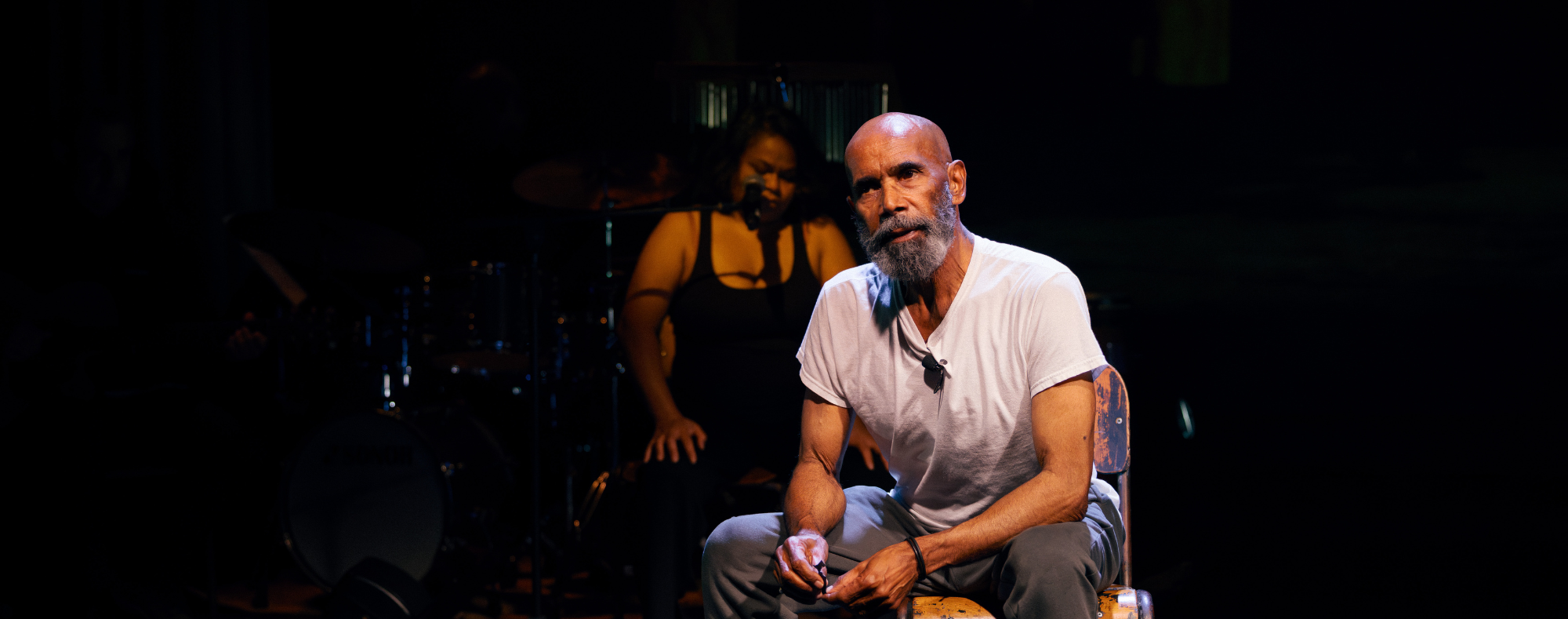
Beyond the Tracks opens with Leslie teaching a dance class. The lingo he employs in his direct address delivery is that straight talk, peppered with Aboriginal slang terms for body parts and behaviour that tells us, we are his black fella students and he is determined to slap us into shape (so to speak).
You see Leslie was a founding student member of the Aboriginal Islander Dance Theatre now simply known as NAISDA, which currently celebrates its fiftieth year since African American dancer and activist Carole Johnson trawled the streets searching for potential bodies to fill the emerging scheme, designed to create a plethora of professional contemporary Indigenous dance bodies for performances in Australian theatres. Those first students came from all walks of life, from coal miners like Malcolm Cole to ballerinas like Rosilyn Watson who had performed with the Queensland ballet, and to Leslie himself, a self-described natural mover who was lured into dancing by a television shampoo advertisement featuring a bevy of beautiful young women dancing on screen. Like Leslie and Cole before me, my dance training upon entering NAISDA was fairly limited and I needed Leslie’s brand of straight talk to remind me, on the days when I could barely get out of bed for the extreme muscular discomfort, that I had a long road to go before I could call myself a professional. Hearing Leslie’s opening gambit brought me right back to those humble beginnings when NAISDA was located in a rundown church in inner city Glebe.
I learned that if it wasn’t for Leslie going to New York to study at Alvin Ailey after receiving a prestigious Fulbright Scholarship in 1980, it wouldn’t be possible for subsequent students including Sylvia Blanco, or myself, to study and graduate from the Martha Graham School and the many others since. It was also confirmed that Leslie was the founder of ACPA, Brisbane’s answer to NAISDA, the Indigenous theatre course at WAAPA, Black Swan Theatre in Perth and our very own Marrugeku Theatre Company.
The staging of Beyond the Tracks was cleverly balanced with text and live music to offset Leslie’s dance. For a guy pushing seventy, Leslie is still in possession of an impressive languid kind of agility. His life’s narrative was expressed through an ongoing tete a tete with collaborator Ursula Yovich which was punctuated with dramatic lunges into the floor, followed by a series of high kicks and several Lester Horton Modern dance sequences. But it was a simple Latin American side to side hip gyration, executed at samba speed as he progressed the expanse of the stage, that really left me in awe.
Ursula Yovich’s singing has the ability to imbue any scene with a sense of intimacy, to make us feel that we are a part of her everyday life, and in this production, she was the conduit between Leslie, the video chronology of his life’s achievements and the band who set the rest of the tone for each of Leslie’s milestones.
Mason Brown’s minimalist set design consisted of a chair, a curtain and a single piece of self standing corrugated iron, which was treated with a reflective surface and attached with a ballet barre. When he sat alone on the chair it somehow emphasised his single minded pursuit and when he moved to the ballet barre we were reminded of his resourcefulness, his make it from nothing struggle. Lastly, when Leslie pulled the curtain over the well worn industrial wall of the former train yard, that served as a cyclorama, we were reminded of his humble beginnings growing up nearby the railway tracks in Moree.
So fitting that Michael Leslie’s life’s reflections this far were shared in Carriageworks just a few hundred metres from the hub that was Black Theatre. However, I also believe that his extraordinary body of work needs to be seen by many more as it represents not only a compelling narrative of survival and success, but a selfless pursuit to bring his community up along with him. So rather than simply list his achievements, I suggest you either look him up for yourself, or better still, book a ticket when this show inevitably makes its theatrical rounds and Sydneyside rebounds.
From Michael Leslie I will now finally regale you with the latest choreographic offerings from Gary Lang, another NAISDA alumni graduating a little after a decade since Leslie began.
Gary Lang is a Larrakia man of many talents – a hairdresser not only able to cut and colour for the blue rinse set, but who entered those competitions where weird and wonderful coifs resembling chandeliers and bird’s nests were par for the course, Lang is also a painter of equal proficiency making images with the same fine detailing. As choreographer Lang navigates narratives with the same attention to detail and sensitivity he does his other side-by-side artistic hustles/ pursuits.
While originally from Darwin I feel safe to also claim Gary as a Sydney based artist, due to his extensive formative training with NAISDA back when it resided in the inner city suburb of Glebe, and his subsequent long-term tenure with both the Aboriginal Islander Dance Theatre and Bangarra Dance Theatre, also residing in the city’s inner suburbs.
For those of you unacquainted with Lang’s body of work, as a choreographer he immediately built a strong rapport with the Yolngu community of Yirrkala situated in North East Arnhem land, through his initial formal exposure at NAISDA. At NAISDA, when learning dances and culture through residencies both in Sydney, when the cultural tutors came to stay, and ‘on country when the student body would conduct training in situ. However, Lang’s strong bond with the Yolngu is almost to be expected, as Larrakia country sits on the Western side of what we refer to as ‘The Top End’, making them neighbours.
Unlike many of Lang’s peers (including myself) who began creating new languages which utilised more of the gestural signatures of the ‘traditional’ Aboriginal dances we were taught, he also developed a strong affinity with the romantic lines of classical ballet. Lang’s choreography is a confluence of the virtuosic long lines created by limbs that can slowly unfurl, appearing to float in the air in seamless combination with cultural torso crouches that appear to alternatively anchor the body, grounding it firmly to the stage’s topography.
Another artist, mentor and teacher who left an indelible imprint on Lang was Paul Saliba. Former principal dancer with the Australian Ballet and Sydney Dance Company under Graeme Murphy before taking up a decades long tenure as teacher and choreographer at NAISDA, Saliba’s lasting influence can be seen in the extensive partnering element shared in many of the NAISDA alumni including Stephen Page, Francis Rings, Sonny Townson, to recent emerging choreographer Beau Dean Riley Smith as well as Lang. Saliba’s inventive sculptural signature is unequivocally most evident in The Other Side of Me where two male dancers in this double hander literally support each other in a myriad of sequences utilising superlative core strength in order to express a maternal bond.
The Other Side Of Me, co-created with dramaturgs and writers Liz Pavey and Dr Laura Fish, chronicles the psychological toll beset upon two boys taken from their Aboriginal family to be sent to an orphanage in Katherine before one was finally relocated to the U.K. has a circuitous history. Lang was originally paired up with celebrated author Laura Fish in 2020, after reaching out to NAISDA CEO Kim Walker, as she was keen for Aboriginal involvement to realise this narrative. Fish (dec) hailed from Northumbria University whose former novels included her most recent titled Lying Perfectly Still was lauded for “lift[ing] normally underrepresented and marginalised voices with empathy and respect”. I couldn’t think of a more appropriate choice to bring this work to the stage as Lang too shares the sensitivity of Dr Fish in handling the issues related to this harrowing Stolen generation story.
Running at a little over forty five minutes Blackdance, the producer of The Other Side of Me, decided to include a short Q&A session after each show, which is how the information regarding the impetus for the work came about. What I found intriguing was the overwhelming audience curiosity regarding certain landmarks throughout the work, wanting to know the facts that initiated those moments. However, Lang responded that it was ultimately up to them, upon learning of the core narrative, to interpret the work as they saw fit. I feel compelled to share that this is very much in line with the practice of tacit knowledge acquisition practiced in many Aboriginal and Torres Strait Islander communities whereby information is gleaned in relation to one’s age and experience, a rite of passage as opposed to a right to access.
Conversely, I was chuffed that I was able to recognise gestures (albeit abstracted) relating to mortuary rites and death spirits, while also understanding this work to be a part of the narrative belonging to men’s business reaffirmed through some of the footwork patterns in combination to the placement of the upper torso.
Lang’s creative team was also well chosen in dancers Blake Escott (Dhunghutti and Worimi) and Alexander Abbot. I would not be exaggerating when I remark that Alexander Abbot has the chiselled body of a Greek god brought to life through the deft hands of a master sculptor, which of course we don’t really fully appraise until he peels off the top layer of his orange overalls. Good thing too or maybe it would have been distracting to the overarching narrative. Escott’s body by comparison belies his youth and potential in its malleable ability. This unlikely pairing of the performers perfectly brought to life concepts of distance, time, corporeality, and inversely, spirituality and belonging. As dancers each possessed their own strengths, Abbott in the long lines his body produced and Escott in his expression of the abstracted Yolngu gestural work, particularly the deft pick up of his feet as he stepped, almost touching his backside, belying his years of training in ‘traditional’ dances from North East Arnhem land.
Additionally, Sam James, as digital media artist, images spoke of country so eloquently we felt the loss of connection so very keenly. Sound designer Sam Pankhurst whose score, which featured the haunting voices of Banula Marika and Janet Munyarryun, under additional sound direction by Arian Pearson, melded the traditional songlines of the Larrakia and Rirratjingu Yolŋu seamlessly.
These two featured works in Michael Leslie’s Beyond the Tracks and Gary Lang’s The Other Side of Me used dance as a crucial historic archive, one – the celebration of a lifetime of extraordinary achievement and the second – a compelling example of truth telling. In part two of my homage to NAIDOC I unpack two works that celebrate the Australian Indigenous Dreaming canon, both differing widely in scale and scope.
Watch this space.
Environment NSW, Topics/Heritage- blue plaques, Malcolm Cole [Accessed July 22nd 2026]
https://www.environment.nsw.gov.au/topics/heritage/blue-plaques/malcolm-cole
Ausdance Queensland, Gaja Rosilyn Watson [Accessed July 22nd 2026]
https://ausdanceqld.org.au/auntyros/
BBC, Tributes paid to Northumbria University writer’s ’empathy and respect,’ 11th October 2024 [Accessed July 22nd 2026]
https://share.google/KEY7Rcg3HIiNbtypr