Home | Blog | Blocked Duwar Feras Shaheen
Blocked Duwar Feras Shaheen
So last Thursday I was feeling quite lethargic and even after being graciously given a ticket to see Feras Shaheen’s latest work Blocked Duwar at Campbelltown Arts Centre, I was contemplating blagging it to get some more lie-down time at home. What the ….?
I know right.
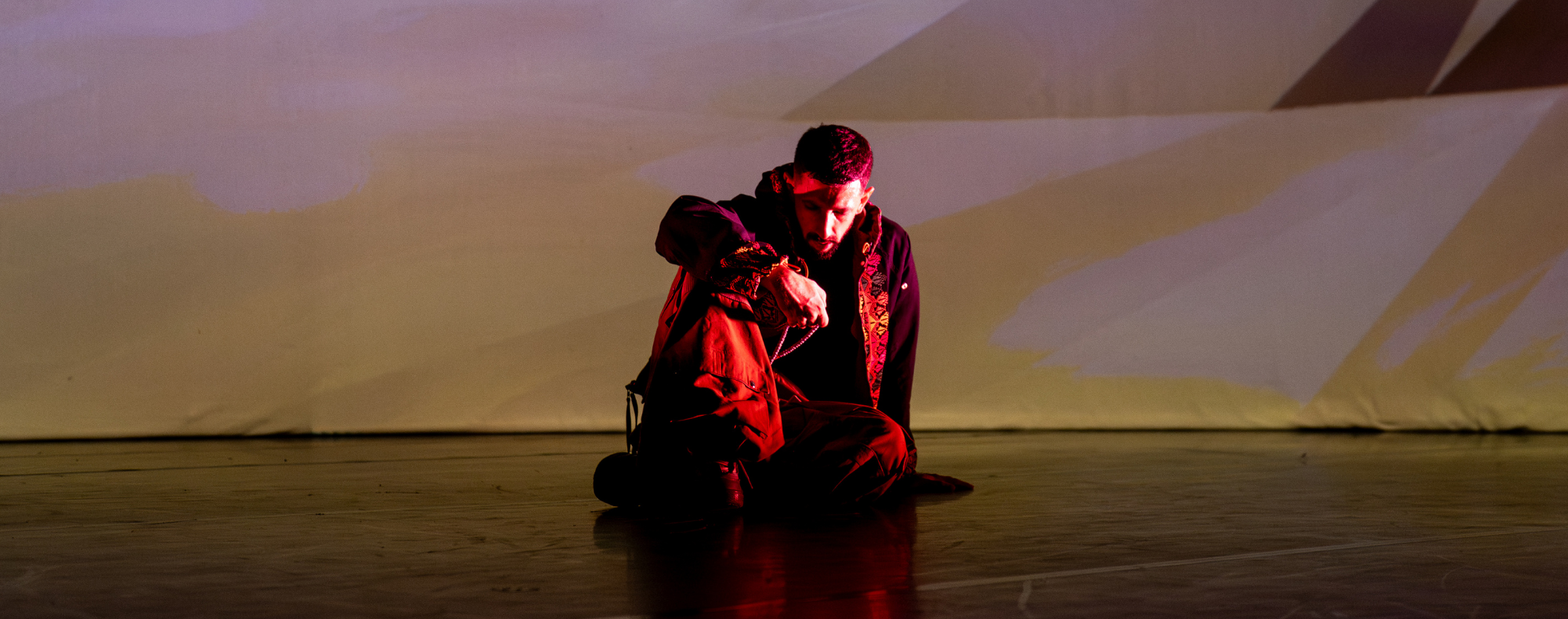
So glad I braved the very minor travel inconvenience. I mean if I’m going to nap (and/or doom scroll) may as well be on a rattler bound for the Western Sydney frontier. Strangely enough this is how Feras and his collaborator Jonny Scholes imagined it too. For in Blocked Duwar the cartography of Palestine is intermingled with that of Campbelltown, through animation as a series of billboards, all contained within a game that dominates the stage via a projection onto a large curved cyclorama, which is hung at a somewhat jaunty angle in relation to the other performing actants.
Ah, let me back up a bit. You see, I was delivered information about the show in tiny morsels, designed to heighten the experience before I actually made it to the final destination. Firstly, after quite a bit of gentle prodding about said show, dance producer Anthea Doropoulos, informed me that I had better have a good app that opens QR codes as Shaheen’s show involved some sort of interactive video element. Secondly, I received both a text and an email warning me about either loud music, or strobe lighting, before cautioning me about a purple tree. A purple tree?
Sure as eggs, when I arrived there were several stations to afford me the opportunity to download “the game”. For a second nighter, the crowded foyer was buzzing like openers. I was offered coffee and tea and dates (the expensive ones) and little round biscuits which I assumed were the edible faire of the art and artists to come. Then I hastily made my way to the theatre with the herd as, after slyly pocketing a few of the plump dates, the buzz of anticipation amplified and engulfed us on our short journey.
So many of Feras’s artistic choices resonated with me as an Australian Indigenous dance maker. From the orientation of the stage with the cyclorama facing Jonny Scholes as game designer, much like the traditional Aboriginal and Torres Strait Islander dance settings whereby the performers face the songmen and percussionists. Like the traditional dances I am invited to perform in front of the general public, little explanation was given regarding our engagement with the game, which was in full swing shortly after we sat.
When the game was formally activated we were encouraged to engage with it. Not conversant with video games (gotta be honest, normally they make me anxious, much like the boardgame Monopoly upon realising you haven’t made a down payment on enough real estate and are subsequently getting screwed over by the landlord represented by a small iron figurine who is cleaning up the bank of all its resources) I just started trying my luck with all the icons at hand. They were comprised of diminutive symbols including a spider, a ghost, an ice cube (or cube of “ice”) and the eggplant, of which I was more than a little suspicious. However, it was the mushrooms which seemed to be going off as they appeared as an ongoing stream up the far
right hand side of the screen. Once I realised that I could contribute to the stream of signage I felt an innate responsibility to keep the flow active. I was not aware if my contribution had any impact, nor if it was helping or hindering the navigation of the desert terrain with the random features of both Campbelltown and Gaza unexpectedly dropping into and onto the barren backdrop.
This game with very scant instructions beside a periodic Q&A asking us how we regard First Nations peoples, to how we shop/ consume goods and services also reminded me of my first experience of participating in Yolngu dances from the Northern Territory. I remember as a student at NAISDA doing a devil dance called Mookuy and being told not to laugh. Of course because of the negative reinforcement my urge to laugh was almost overwhelming, however it was quelled by the warning, which also imbued the dance with facets of mystery and power. This same sensation of foreboding was layered onto my participation in this gaming scenario. The not-knowing could equally be applied more prosaically in this gaming context, used as a metaphor for being supplanted into an alien society and expected to just blindly navigate the new rules of law and etiquette. At this moment I realised I could not imagine how hard it would be to come to Australia from Palestine and be expected to successfully lay down roots.
Debriefing on the way home with two scholarly mindsets, I realised that amongst the Shaheen family pictures and interviews of and from Palestine, I missed half of the imagery, including Shaheen as possible victim of a bombing on a bridge (which incidentally was accompanied by several loud mic drops). How did I miss that? However, I did see the purple tree and formed my own opinion as to its significance, of which I won’t divulge as I think this work deserves a grand tour and too many spoilers would be a detriment to ongoing audience experience.
Of course I would be remiss if I did not speak of Shaheen’s dancing body. Not because this is billed as a dance piece but because when he dances time stands still. Yes, Shaheen is that good. The quick twitch involved to be a fabulous hip-hopping b-boy was expertly mixed with the embodiment of his cultural ancestry. I remember seeing him dance the dabke with his mother in Parramatta in the little pergola (I can’t recall if this is a permanent piece of architecture just kitted out, or if it was a tiny purpose built stage) in the park that backs Parramatta Riverside Theatres. It was part of a festival organised by Form Dance Projects. What I do remember was the intricate embroidery on the costumes and Shaheen’s unabashed commitment to family and legacy.
In Blocked Duwar, like his appearance in Parramatta, Shaheen has both held and brought his family legacy to us in an embodiment whereby, much like fast food, we are never quite satiated. In Blocked Duwar he has not kowtowed to Western theatrical convention which demands a certain organisation and footnotes to any possible deviation. Instead, along with his formidable team including Jonny Scholes and musician Madji Nelda, bespoke costume recycler/ designer Noah Johnson, sound designers Jenny Trinh and Dylan Mangunay, lighting designer Fausto Brusamolino, movement consultant Efrin Pamilican, dramaturg Jazz Money et al, Shaheen has maintained an integrity in alterity to the biggest threat in theatre today – that is homogeneity. For it is global ubiquity which slowly erodes our propensity for empathy, the ability to meaningfully
connect with those experiences that exist outside our own personal experiential framework and the framework often dictated by those wielding the most money and power.
Much kudos to Shaheen and his team for speaking their, and our, truth and equal shout outs to Campbelltown Arts Centre for giving a critical platform to these artists who deserve to be heard in both homes Western Sydney and the West Bank and Gaza Strip.
Much fodder for continued contemplation.
So again folks, until the next installment.