Home | Blog | Sydney Festival – Ahn / Jannawi / Bray
Sydney Festival – Ahn / Jannawi / Bray
As usual, my 2026 Sydney Festival experience has started with a bang, with the South Korean Eun-Me Ahn Dance Company performing Post Orientalist Express. As I found my allocated seat a dancer was already seated on a small toy chair, with what looked like rabbit ears serving as back support, facing a floor to ceiling scrim. A montage of Asian images was projected as a small round window upon the scrim, which included some familiar Hollywood nostalgia scenes featuring Yul Brenner, peppered with more harrowing imagery taken from Japanese films, including a man trying to escape the shackles of worn wooden stocks.
The show proper began as a character dressed in ornate gold costuming with a white mask and a bell glided towards the scrim from behind. The character rang the bell for the scrim to rise before moving towards the now reclining (slumbering?) performer and rang the bell repeatedly until the performer regained consciousness and together they exited as the scrim rose to reveal the set, which was covered with circular disks, each containing an Asian patterned print set against a silver backdrop. This ornate backdrop would be a clue to how this show would unfold.
Ahn’s preferred colour palette is LOUD, featuring the kind of colours existing after closing one’s eyes after staring into the sun, or upon being slightly concussed, or after accidently over medicating one’s self on narcotic pain relievers. The added use of ultraviolet lighting enhanced the preference for lurid colours that only make logical sense in dreams.
The costumes, 90 in all and designed by Ahn herself, facilitated this Willy Wonka hyperreality. One garment cut the body in two headless halves, another ensemble, more readily identified as Asian, featured large rectangular sleeves for the arms to fly. There were also ornate gowns hiding the feet for the dancers to float, odd socks to slide, nun-chucks waving rapidly to appear as if the dancing body were engulfed in lasers and a mop of coloured rafia adorned on a dancer’s head creating an effect of a rabid creature on steroids. Whereas the dance consisted of a relentless mixture of kaleidoscopic floor patterning peppered with gymnastic feats of the circus ilk.
I thoroughly enjoyed this work as it was an endorsement for those vocabularies and physicalities and aesthetics that are not derivative of the European court in classical ballet, which still enjoys a ubiquitous dominance on the Australian concert stage. Alternatively, Ahn offered a sense of ordered chaos as the dance du jour and after a while the onslaught of movement and colour became the meditative norm for this witness.
The next two events I attended as part of my 2026 Sydney Festival experience were Australian First Nations in Janawi Dancers director Peta Strachan’s Garrigarrang Badu meaning Saltwater/Freshwater and Joel Bray’s Garabari, the Wiradjuri language name for corroboree, or dancing place.
For Strachan I felt Garrigarrang Badu represented a rite of passage, encapsulating her growing renown as a contemporary choreographer transitioning from the commercial stage to the concert stage on a very grand scale. This choreography also consolidated her role as a cultural elder in waiting, speaking of and to her country and her Dharug ancestral lineage in Western Sydney.
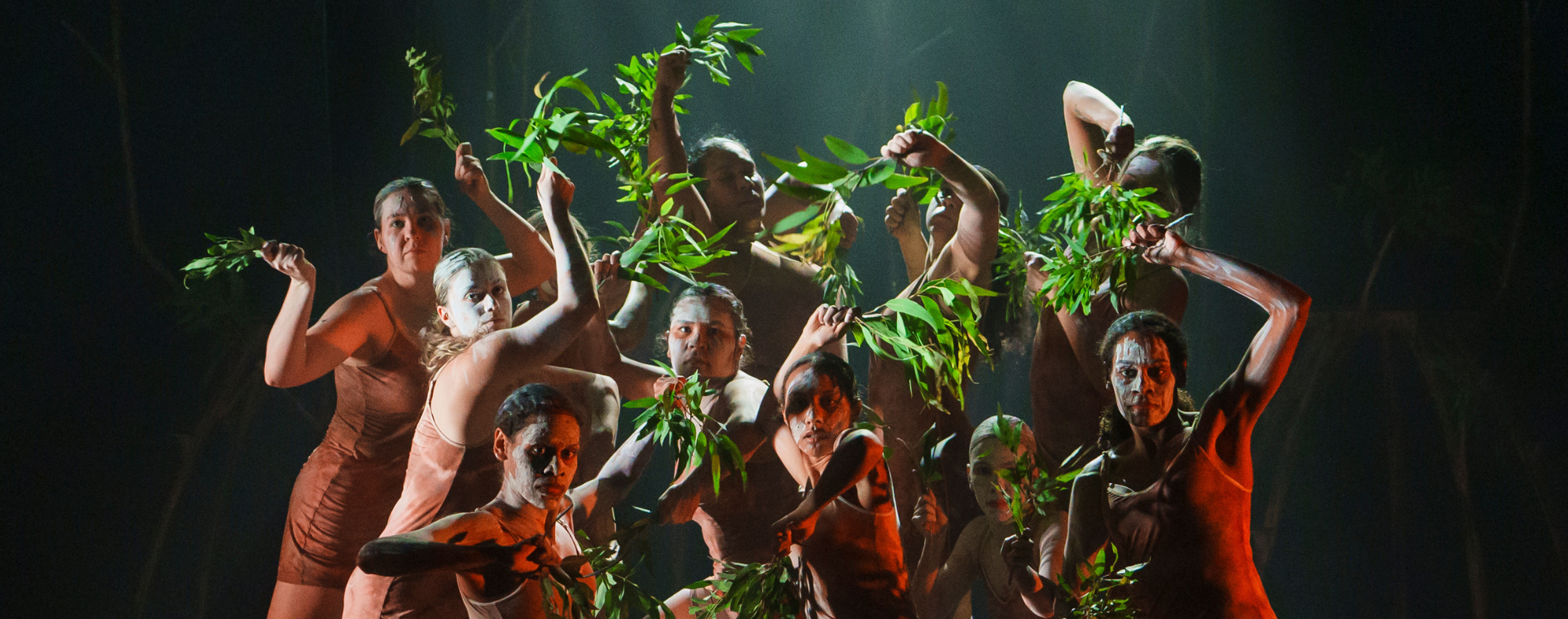
Strachan’s production included a cast of fourteen dancers. Her set contained several floor to ceiling scrims forming two stage spaces, complete with several large roving sculptural platforms that when placed together formed a women’s shelter able to accommodate the entire cast. One section featured the full cast, the moving foliage and five canoes! Yes you saw this right – canoes. Until my eyes beheld this spectacle I didn’t think the drama theatre of the Sydney Opera House could hold a set of a scale normally reserved for the much larger Dame Joan Sutherland/Opera theatre.
As a NAISDA Dance College and Bangarra Dance Theatre Alumni, the dance transported me to my comfort place. I recognised the influence of Yolngu dances, and rightly so in Strachan’s case as she has had a long association taking part in and performing with the Yolngu community, and her two eldest children Gupala and Dubs Yunupingu, who were in heavily featured, are also Yolngu. I also recognised elements of Torres Strait Islander Dance, which is also emblematic of the training I share with her through the experience of NAISDA. The TSI aspect was also reflective of the collaborative input from Torres Strait Islander choreographic collaborator Albert David, along with Islander cast members Harlisha Newie-Joe and Buia David.
The buzz in the foyer afterwards focused on how heartening it was to see the stage filled with a cast of strong women dancing together with such fierce commitment. Dubs Yunupingu led the show, supplying much of the emotive gravitas to the unfolding episodic narrative, while again and again my eye was drawn to Buia David whose embodiment similarly drove the choreography.
Amongst so many standout moments yet another dancer I found my eye drawn to in this production was Abigail Delaney. Delaney’s gestural interpretation was imbued with an honesty that transported me to the Dharug camp.
My first Sydney Festival week culminated with Joel Bray’s contemporary corroboree Garabari. Just before we entered the dance site Bray himself reminded us that two centuries beforehand corroborees were conducted under the watchful eyes of the first settlers before Chandler ‘Cheeky’ Connell lifted our spirits by officially welcoming us to join the event, in his Wiradjuri tongue.
We processed en masse through a corridor of dancers led by songman Matthew Doyle. I was so buoyed by this entrance that I joined in assuming the lowered centre of gravity and performing a song cycle Doyle crafted. This opening was a highlight as it shone a befitting spotlight on Doyle as the first NAISDA alumni to be bestowed the honour of singing alongside elders from many of the remote communities who shared their Dreamings with the college. Doyle is widely respected for having set a precedent for the revitalisation of song and dance for many Indigenous clans dispossessed of ceremony, especially in New South Wales.
The contemporary corroboree dance ground at the Opera House was located on the North side, facing the water’s edge. Cheeky Chandler resumed his role as emcee of sorts, rousing the crowd and getting them to replicate the animals featured within the overarching Dreaming narrative, of the creation of the Murrumbidgee river system, which held the event together.
Fun fact, I too have utilised this Dreaming narrative of how the rivers were made on Wiradjuri country, as the underpinning driver of my work Briwyant, which was an embodied expression of the relationship between ancestors and community, evoked through the production of a shimmer effect and realised in the act of painting. My song cycle was also crafted with Joel’s father, lauded Wiradjuri language teacher Christopher Kirkbright, sixteen years beforehand. Like Bray, my work was also a testament to how dance is a component of multi-faceted creative expression in order to strengthen community. For Bray his overarching creative strategy lies in breaking the audience/ performer relationship, in his ability to lure the audience into his world. Garabari exemplified the epitome of the inclusivity that Joel endorses.
I just hope the ensuing Sydney Festival dance calendar lives up to the bar this week of events has set.
As usual, watch this space for the next blog and also the bonus blogs that didn’t quite make the site due to my cat’s unfortunate misadventures.
Vicki Van Hout
FORM Dance Projects
Blogger in Residence
*The views expressed in this article are those of the author and do not necessarily reflect the views of FORM Dance Projects or its affiliates.